Magnets are used in the industry for a long time, but knowing the magnet’s capacity was not possible until McNetiq
B.V. introduced the innovative Controlock magnet and the testing system, the Controlock® magnet anchor. In this
article, you will read about
- What is Controlock® magnet anchor?
- Cutting-edge approach
- Benefits
- Permanent magnets
What is the Controlock® magnet anchor?
In 2014 Bas Gravendeel and Edwin van der Heide established McNetiq B.V. to promote the Controlock® magnet anchor technology.
Controlock® is a magnetic scaffold anchor that replaces temporary steel connections in the industrial and marine fields.
The system measures the adhesive force of the used magnet with 100% accuracy, making it possible for the first time to determine the
magnetic capacity.
Controlock® anchor is, therefore, certified by DIBT, Dekra, and Lloyds, among others. Besides, the firm received many
awards for this technology.
Cutting-edge approach
Compared to traditional steel connections such as drilling and welding, scaffolds built with Controlock® are constructed against steel walls such as storage
tanks and ships without the need to use welding or a large abutment base to stabilize the scaffold.
Benefitsh
When you use the magnets to support your scaffold, you will reduce the materials used to construct the structure, and you will minimize the logistics
footprint. Also, you will scale down the building time and decrease the needed workforce. Therefore, the system is
The mentioned advantages encourage scaffolding companies to switch to using magnets. Furthermore, Based on the Contrlock®, the firm developed
many applications, such as the
Scaffold Anchor ,
Pipe Support,
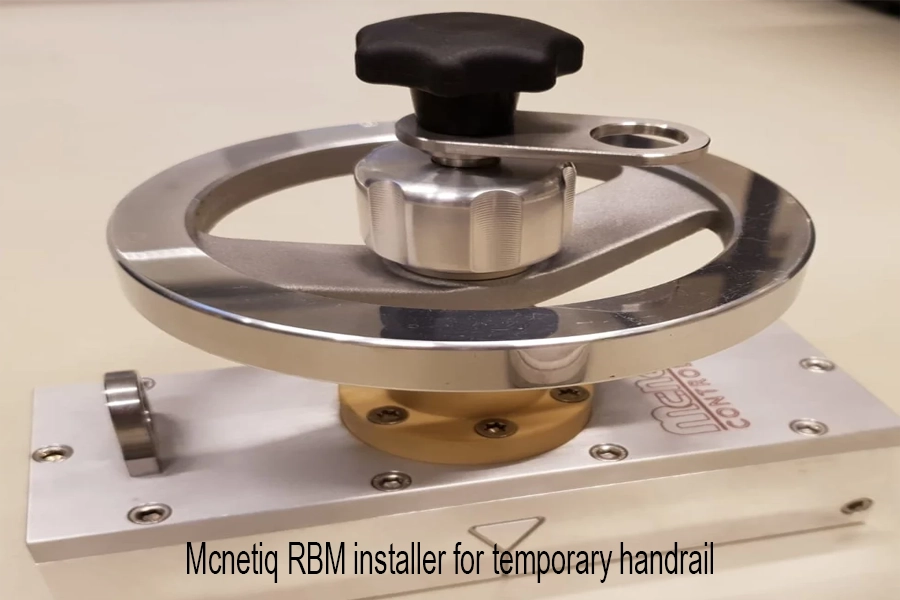
Fall Arrest, Temporary handrail.
“With McNetiq Controlock® anchor, a scaffold can indeed be securely anchored: lean and mean, only
where required. The result: savings of 40% on lead time and 70% on materials.”
Permanent magnets
The Controlock magnet anchor’s main component is neodymium, which means permanent magnets, with the ability to be turned on and off manually.
The benefit of using permanent magnets as temporary steel connections is that they don’t need an external source of power, which makes permanent magnets
safer compared to electromagnets. Electromagnets are always dependent on a constant external power source to function. If this magnet’s power source is
lost or the connection fails, this can have catastrophic consequences. For the manual For more information take a look
at our downloads section or
contact us